|
Keynote Presentations
Visual Studio 2005: A World of New Opportunity
Soma Somasegar, Corporate Vice President, Developer Division, Microsoft
Monday, January 30, 9 a.m.
 Explore all the new VS ’05 features, from language enhancements, improved designers, and smart-client development tools to Visual Studio Team System — a suite of software lifecycle management tools poised to transform how you deliver software. Learn how to improve your projects and save time with this watershed release. Explore all the new VS ’05 features, from language enhancements, improved designers, and smart-client development tools to Visual Studio Team System — a suite of software lifecycle management tools poised to transform how you deliver software. Learn how to improve your projects and save time with this watershed release.
S. "Soma" Somasegar is corporate vice president of the Developer Division at Microsoft Corporation. The Developer Division is primarily responsible for all the developer-related languages, tools and platforms within Microsoft, including Visual Studio, Web Platform and Tools, .NET Framework, Common Language Runtime (CLR) and other .NET Developer Platform technologies. In addition, he oversees the India Development Center (IDC) in Hyderabad, India.
Building Modern Software: Services, Workflow, Integration
David Chappell, Principal, Chappell & Associates
Tuesday, January 31, 9 a.m.
 The move to a service-oriented world, made possible by the rise of Web services, is today's most important trend in software development. To fully take advantage of this architectural shift, organizations frequently need to combine traditional integration technologies, Web services, and workflow. In this keynote presentation, David Chappell will provide an introduction to Windows Communication Foundation (WCF, formerly code-named "Indigo"), Microsoft's forthcoming framework for creating service-oriented applications. He'll also describe Windows Workflow Foundation (WF), a framework for creating workflow-based applications, and look at the role of BizTalk Server 2006 as well as the impact WCF and WF will have on this business integration server. Don't miss this keynote if you're looking for the big-picture view of how Windows will support the applications required for a service-oriented world. The move to a service-oriented world, made possible by the rise of Web services, is today's most important trend in software development. To fully take advantage of this architectural shift, organizations frequently need to combine traditional integration technologies, Web services, and workflow. In this keynote presentation, David Chappell will provide an introduction to Windows Communication Foundation (WCF, formerly code-named "Indigo"), Microsoft's forthcoming framework for creating service-oriented applications. He'll also describe Windows Workflow Foundation (WF), a framework for creating workflow-based applications, and look at the role of BizTalk Server 2006 as well as the impact WCF and WF will have on this business integration server. Don't miss this keynote if you're looking for the big-picture view of how Windows will support the applications required for a service-oriented world.
David Chappell is Principal of Chappell & Associates (www.davidchappell.com) in San Francisco, California. Through his speaking, writing, and consulting, David helps IT professionals around the world understand, use, and make better decisions about enterprise software technologies. David has been the keynote speaker for conferences in the U.S., Europe, Latin America, and the Middle East, and his seminars have been attended by tens of thousands of developers and decision makers in thirty-five countries. David's books on enterprise software technologies have been translated into ten languages and used in courses at MIT, ETH Zurich, and other universities, and more than 100 of his articles have appeared in various publications. His consulting clients have included Hewlett-Packard, IBM, Microsoft, Stanford University, Target Corporation, and others. David holds a B.S. in Economics and an M.S. in Computer Science, both from the University of Wisconsin-Madison.
SA Summit Keynote: Architecting for Scalability
Pat Helland, Amazon.com
Tuesday, January 31, 10:30 a.m.
 The first step to creating scalable apps is to learn how to think about creating them properly in the real world. For example, how do you to consider data access patterns, how should you approach messaging, and how do you ensure your application several critical goals that are critical to scalability. These goals include the assumption that no transactions across nodes because they are fragile). You must also be able to write your app with an eye toward changing its deployment later to cope with increased scalability requirements (you don’t want to change a single line of app code, just redeploy). This talk will explain the characteristics required by such an application, as well as walk you through the design patterns you must employ to achieve this kind of effect. The first step to creating scalable apps is to learn how to think about creating them properly in the real world. For example, how do you to consider data access patterns, how should you approach messaging, and how do you ensure your application several critical goals that are critical to scalability. These goals include the assumption that no transactions across nodes because they are fragile). You must also be able to write your app with an eye toward changing its deployment later to cope with increased scalability requirements (you don’t want to change a single line of app code, just redeploy). This talk will explain the characteristics required by such an application, as well as walk you through the design patterns you must employ to achieve this kind of effect.
Pat Helland has 25 years of experience in the software industry and has recently joined Amazon as a senior technology manager. Prior to Amazon, Pat was an architect at Microsoft. He has worked for more than 20 years in database, transaction processing, distributed systems, as well as fault tolerant and scalable systems. From 1982 through 1990, Pat worked at Tandem Computers and was the Chief Architect of TMF (Transaction Monitoring Facility), the NonStop System’s Transaction Processing implementation. He was one of the founders of the team that implemented and shipped MTS (Microsoft Transaction Server) now COM+. He was the chief architect for Yukon’s SQL Service Broker product. Pat has worked in the Architecture Strategy Team where he has focused on loosely-coupled application environments and Service Oriented Architectures.
SA Summit Keynote: Deploying Oracle Database 10g on the Windows Platform
Mark Townsend, Senior Director of Database Product Management, Oracle Corporation
Tuesday, January 31, 11:45 a.m.
 All businesses today are faced with the technology challenge of meeting higher service level objectives and the economic challenge of reducing IT costs. How can IT architects get the most of out their resources and take advantage of advances in hardware and software architectures? Oracle's commitment to Windows and .NET enables customers to take full advantage of their .Net development resources and take full advantage of the performance, reliability and scalability of Oracle Database 10g on the windows platform. Join us and learn how to architect Oracle Database 10g deployments for the windows platform. During this session, we'll discuss customer case studies and demonstrate the tight integration between .Net and Oracle Database 10g. All businesses today are faced with the technology challenge of meeting higher service level objectives and the economic challenge of reducing IT costs. How can IT architects get the most of out their resources and take advantage of advances in hardware and software architectures? Oracle's commitment to Windows and .NET enables customers to take full advantage of their .Net development resources and take full advantage of the performance, reliability and scalability of Oracle Database 10g on the windows platform. Join us and learn how to architect Oracle Database 10g deployments for the windows platform. During this session, we'll discuss customer case studies and demonstrate the tight integration between .Net and Oracle Database 10g.
A 15-year Oracle veteran, Mark Townsend is Senior Director of Product Management in Oracle's Server Technology Division, where he's currently responsible for the rollout and R&D planning of database releases. His role involves regular discussions with developers, customers, and partners to better understand their IT and business requirements and challenges.
How We Make the Sausage: Lessons from "the Factory Floor" on How Microsoft Does Software Engineering
Russ Ryan, Product Unit Manager, Developer Division Customer Product-Lifecycle Experience Team, Microsoft
Tuesday, January 31, 2 p.m.
 How does the Microsoft developer division produce software? As we roll out Visual Studio 2005 lots of people have asked about our development process and the tools we use. We learned a lot during the VS 2005(Whidbey) development cycle. This talk will show how we started out, what we learned, and show some of the engineering practices and improvements we have set in place to make the next version even better. How does the Microsoft developer division produce software? As we roll out Visual Studio 2005 lots of people have asked about our development process and the tools we use. We learned a lot during the VS 2005(Whidbey) development cycle. This talk will show how we started out, what we learned, and show some of the engineering practices and improvements we have set in place to make the next version even better.
Russ Ryan has been at Microsoft for 9 years, but not all at once. He led Microsoft groups that developed C Compilers and the LAN Manager in the years 1982-1988, then left to pursue other goals including a couple of startup companies. The last of these was Chili!Soft, a company that produced a cross-platform Active Server Page (ASP) product for Solaris and Linux. The company was eventually acquired by Sun Microsystems. In 2002 Russ rejoined Microsoft where he is Product Unit Manager (PUM) for the Developer Division Customer Product-Lifecycle Experience Team. This group is responsible for working with developers to help them succeed throughout the lifecycle of Visual Studio and .NET Framework products. It includes Service Releases, After Market Solutions, and Customer Connections (feedback and transparency).
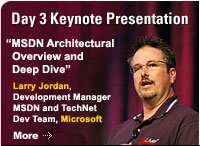
MSDN Architectural Overview and Deep Dive
Larry Jordan, Development Manager, MSDN and TechNet Development Team, Microsoft
Wednesday, February 1, 9 a.m.
 MSDN is the critical resource for developers working with Microsoft tools and products. We'll demonstrate the new MSDN Website which has been newly architected to offer superior scale and productivity for developers. The MSDN team bet huge on 64 bit Windows Server 2003, SQL Server 2005 and ASP.NET 2.0 and the launch will be coordinated with the release of Visual Studio 2005 family of products. The new site and library will be 100 percent data driven based on SQL Server 2005 and we will be demonstrating our latest Web Services interfaces and diving deep into other details of the system. MSDN is the critical resource for developers working with Microsoft tools and products. We'll demonstrate the new MSDN Website which has been newly architected to offer superior scale and productivity for developers. The MSDN team bet huge on 64 bit Windows Server 2003, SQL Server 2005 and ASP.NET 2.0 and the launch will be coordinated with the release of Visual Studio 2005 family of products. The new site and library will be 100 percent data driven based on SQL Server 2005 and we will be demonstrating our latest Web Services interfaces and diving deep into other details of the system.
Larry Jordan is the development manager for the MSDN and TechNet Web sites and core Microsoft.com infrastructure. His team is responsible for site-wide applications consisting of rendering, personalization and large-volume technical publishing for Microsoft’s Developer and IT Professional audiences. He considers himself a customer of Microsoft products and is dedicated to improving Microsoft enterprise applications in one the world’s most demanding IT environments.
Business Process Modeling
Ted Buszkiewicz, Manager, Business Systems Architecture and Enterprise Architecture Program Architecture & Application Infrastructure Services, Hewlett Packard
Wednesday February 1, 10:30 a.m.
 Real life business processes are complex and require intelligent decisions on the part of their participants at each step of the way. But modeling and execution language, combined with service components and service-oriented middleware, are making it possible to automate even large and seemingly ambiguous business processes. This talk examines the technology advances that make this possible, describes how specific techniques are applied to major steps of the business process, and brings them together to deliver the big picture of modeling and automating seemingly difficult processes. The talk draws from real life examples of how architects have applied specific design principles to successfully overcome hurdles to build complete software systems based on legacy business processes. Real life business processes are complex and require intelligent decisions on the part of their participants at each step of the way. But modeling and execution language, combined with service components and service-oriented middleware, are making it possible to automate even large and seemingly ambiguous business processes. This talk examines the technology advances that make this possible, describes how specific techniques are applied to major steps of the business process, and brings them together to deliver the big picture of modeling and automating seemingly difficult processes. The talk draws from real life examples of how architects have applied specific design principles to successfully overcome hurdles to build complete software systems based on legacy business processes.
Ted has been with HP since 1993. He has held a variety of architecture management positions at the corporate and group level. Most recently he was the Consumer Business Architect and HP’s Order Management Manager in the clean room. Since the merger, he directed the PSG IT Architecture & DKM team. His group managed the processes for developing PSG IT’s strategic architecture and reviewing projects for architectural fit.
Prior to joining HP, Ted had about 20 years experience in IT after teaching math at the high school and technical college level. He worked for consulting firms that developed mainframe solutions for customer to cash, financials, and manufacturing. The advent of packaged ERP solutions caused him to shift from a tactical development focus to a strategic architecture focus.
SA Summit Keynote: Software Architecture on the Edge: Moving Beyond SOA
John deVadoss, Director, Architecture Strategy, Microsoft Corporation
Wednesday February 1, 11:45 a.m.
 The software landscape is rapidly changing, and the need for a new architecture to accommodate these changes is rapidly emerging. The emergence of the software as a service (SaaS) paradigm has created opportunity for development of powerful applications that operate on the edge as we as within the cloud. The business and social models that drive software and commerce are changing as well. All of this means that software architects have to take a step back and think about what lies over the horizon. To move beyond SOA means finding a way to connect the Edge to the existing services infrastructure. This talk will take a look at a new architecture to address this issue. The software landscape is rapidly changing, and the need for a new architecture to accommodate these changes is rapidly emerging. The emergence of the software as a service (SaaS) paradigm has created opportunity for development of powerful applications that operate on the edge as we as within the cloud. The business and social models that drive software and commerce are changing as well. All of this means that software architects have to take a step back and think about what lies over the horizon. To move beyond SOA means finding a way to connect the Edge to the existing services infrastructure. This talk will take a look at a new architecture to address this issue.
John deVadoss is Director of Architecture Strategy at Microsoft. He has 15 years of experience in the software industry; he has been at Microsoft for 8 years, all of it in the enterprise space – as a consultant, as a program manager in the distributed applications platform division, as an architect working with some of Microsoft’s key partners, and most recently leading solutions architecture evangelism. Prior to Microsoft he spent many years as a technology consultant in the financial services industry in Silicon Valley. His areas of interest are broadly in distributed application architecture, data and metadata, systems management and currently on edge architectures (both services and access), but most of all in creating business value from technology investments.
New Visions & Opportunities
Panel Discussion
Wednesday, February 1, 2 p.m.
Learn how to take your skills as a Windows developer and use them in exciting new areas including: Home video, Instant Messaging, dynamic online satellite imagery and Avalon objects. We’ll cover Windows Media Center, MSN IM APIs, Vista Gizmos, and Virtual Earth: Microsoft Motion: Business Value through Business Architecture
"Motion": the code name for an incubation methodology to organize, measure, and evaluate the capabilities that make up an organization's business architecture in a way that is highly complementary to the process maps that are common in many organizations. Join the team behind Microsoft Motion and learn how it leverages a patent-pending, systematic approach to understanding today's constantly changing and increasingly complex business models (business today is always in motion and business architecture offers a more stable measurable view of that business), offering a set of tools to help map, understand and quantify the capabilities of an organization and tie them to relevant process, organization, and technology views. Discover tools and measures to help attach key metrics and other data to capability, so that evaluating and discussing the performance improvement of a capability can be quantified in very specific terms. The prescriptive methodology — having already been tested with customers for almost two years with compelling results — exposes when it makes sense to just cut costs out of a capability, as opposed to invest in something to get it to perform at a best practice level, all in language that is understandable to business people and IT people alike.
Go Peer-to-Peer with MSN Messenger Activity API
 Take a cruise through the MSN Messenger Activity API and learn how you can build interactive peer to peer applications in Messenger. The Activity API enables you to take advantage of MSN Messenger’s communication infrastructure to interact with IM conversations and pass data between MSN Messenger clients without having to worry about the normal Internet connectivity issues of crossing firewalls, NATs, proxies, etc. The Activity API enables you to build rich interactive applications for an audience of 170 million MSN Messenger users world-wide. Take a cruise through the MSN Messenger Activity API and learn how you can build interactive peer to peer applications in Messenger. The Activity API enables you to take advantage of MSN Messenger’s communication infrastructure to interact with IM conversations and pass data between MSN Messenger clients without having to worry about the normal Internet connectivity issues of crossing firewalls, NATs, proxies, etc. The Activity API enables you to build rich interactive applications for an audience of 170 million MSN Messenger users world-wide.
Building Virtual Earth Powered Apps—for Fun and Business
 We will guide users through the process of creating a series of map applications utilizing Virtual Earth and Windows Live Local. We will cover the basics of integration with different data sources, how to customize the look and feel of the Map Control, and other useful tips for building Virtual Earth powered applications. Included will be coverage of existing applications using Virtual Earth today for both fun and business. We will guide users through the process of creating a series of map applications utilizing Virtual Earth and Windows Live Local. We will cover the basics of integration with different data sources, how to customize the look and feel of the Map Control, and other useful tips for building Virtual Earth powered applications. Included will be coverage of existing applications using Virtual Earth today for both fun and business.
Get More Productive with Vista Gadgets for Windows Sidebar
 Windows Vista includes an exciting new platform for developers. Gadgets are mini-applications which help people be more productive at work, at home, and on the go. Gadgets can connect to Web services, integrate with desktop applications, or provide a huge variety of standalone functions. Gadgets can be easily organized in Windows Sidebar (a standard feature in Windows Vista), or can be placed anywhere on the desktop. Best of all, gadgets are easily developed with standard DHTML techniques. Gadgets help you connect with your users and customers in new and engaging ways, and their potential is limited only by your imagination. See a demo of some of the latest gadgets for Windows Sidebar and learn more about how you can begin creating your own gadgets as soon as possible. Windows Vista includes an exciting new platform for developers. Gadgets are mini-applications which help people be more productive at work, at home, and on the go. Gadgets can connect to Web services, integrate with desktop applications, or provide a huge variety of standalone functions. Gadgets can be easily organized in Windows Sidebar (a standard feature in Windows Vista), or can be placed anywhere on the desktop. Best of all, gadgets are easily developed with standard DHTML techniques. Gadgets help you connect with your users and customers in new and engaging ways, and their potential is limited only by your imagination. See a demo of some of the latest gadgets for Windows Sidebar and learn more about how you can begin creating your own gadgets as soon as possible.
Powerful and Fun and Convenient Apps, See What MCE Can Do
 Join members from Microsoft Windows XP Media Center Team and learn what MCE can do—and a whole lot more. You’ll see applications that harness the power and flexibility of the Web, fun of gaming, and convenience of e-mail and instant messenger. You’ll also learn how to make the most of digital entertainment—photos, music, TV, movies, home videos, radio, and a world of applications and services whether you're sitting in front of your Windows desktop or across the room with a remote control. Join members from Microsoft Windows XP Media Center Team and learn what MCE can do—and a whole lot more. You’ll see applications that harness the power and flexibility of the Web, fun of gaming, and convenience of e-mail and instant messenger. You’ll also learn how to make the most of digital entertainment—photos, music, TV, movies, home videos, radio, and a world of applications and services whether you're sitting in front of your Windows desktop or across the room with a remote control.
|